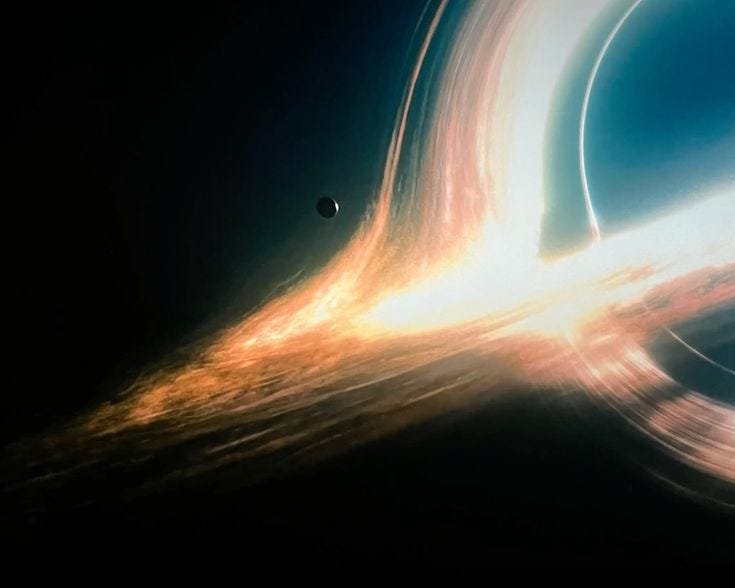
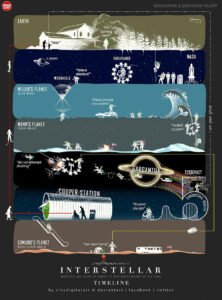
Interstellar Timeline Explained – Cooper, Murph, And The Tesseract Timeline
Interstellar has one of the most complex timelines in modern science fiction movies. The story involves time dilation, black holes, and a fifth-dimensional tesseract, which makes the timeline confusing for many viewers.
Earth Timeline
On Earth, Murph grows up while Cooper travels through space. Because of time dilation, time moves much slower for Cooper than it does on Earth.
Millers Planet
When the crew lands on Miller’s Planet, every hour on the planet equals seven years on Earth. This is one of the most important moments in the timeline because Murph ages many years while Cooper only experiences a few hours.
Mann’s Planet
After Miller’s Planet, Cooper and the team travel to Mann’s Planet. More time passes on Earth while Cooper continues the mission.
The Black Hole And The Tesseract
Near the end of the movie, Cooper enters the black hole Gargantua and finds himself inside a tesseract where he can see different moments in Murph’s room across time.
The Ending Timeline Explained
Cooper realizes that he was the “ghost” Murph saw in her room. He was communicating with her through gravity from the future, which creates a time loop.
Final Thoughts
Interstellar’s timeline is a loop where the future affects the past. This is why Cooper was able to communicate with Murph and help humanity survive.