
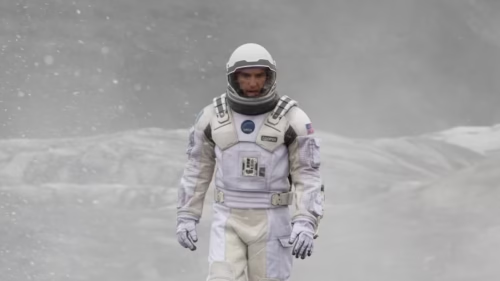
If you loved Interstellar, the best movies to watch next are Arrival, The Martian, Gravity, Contact and Sunshine. Christopher Nolan’s 2014 film mixes hard science, a father-daughter story and a mind-bending look at time, so the right pick depends on which part hooked you most. This list sorts 10 space movies by what they share with Interstellar, and tells you how each one is different.
Last updated: October 20, 2026.

Quick guide: pick your next space movie by what you loved most about Interstellar.
Quick picks: which Interstellar-style movie should you watch?
- Want the science and survival? The Martian, Gravity
- Want the emotional, time-bending story? Arrival, Contact
- Want a dark, tense space mission? Sunshine, Prometheus
- Want slow, lonely and philosophical? 2001: A Space Odyssey, Ad Astra, Moon, Passengers
What made Interstellar special?
Interstellar follows Cooper (Matthew McConaughey), a former pilot who leaves his daughter behind to search for a new home for humanity through a wormhole near Saturn. It stands out for three things: science built with physicist Kip Thorne, including its black hole Gargantua; the way time dilation turns into an emotional event, since an hour near the black hole costs years back on Earth; and Hans Zimmer’s organ-heavy score. The films below each share at least one of those qualities.
Comparison table
| Movie | Year | Director | Best for |
|---|---|---|---|
| The Martian | 2015 | Ridley Scott | Science and survival, with humor |
| Gravity | 2013 | Alfonso Cuarón | A tense survival thriller |
| Arrival | 2016 | Denis Villeneuve | Emotion, language and time |
| Contact | 1997 | Robert Zemeckis | Science versus faith |
| Sunshine | 2007 | Danny Boyle | Psychological dread |
| Prometheus | 2012 | Ridley Scott | Big questions with horror |
| 2001: A Space Odyssey | 1968 | Stanley Kubrick | Slow, philosophical sci-fi |
| Ad Astra | 2019 | James Gray | A father-and-son journey |
| Moon | 2009 | Duncan Jones | Isolation and identity |
| Passengers | 2016 | Morten Tyldum | A lighter, romantic take |
Sci-fi movies with real science and survival
1. The Martian (2015)
Director: Ridley Scott. Stars: Matt Damon, based on Andy Weir’s novel.
Why it fits: Astronaut Mark Watney is left behind on Mars and has to solve one engineering problem after another to stay alive while NASA works on a rescue. Like Interstellar, it believes science and teamwork can beat impossible odds.
How it differs: It is much lighter in tone and full of jokes, with no cosmic mystery at the center.
Best for: Viewers who loved the problem-solving side of Nolan’s film.
2. Gravity (2013)
Director: Alfonso Cuarón. Stars: Sandra Bullock, George Clooney.
Why it fits: After debris destroys their shuttle, two astronauts fight to get home from low Earth orbit. It captures the same awe and terror of silent space, and Cuarón won the Oscar for Best Director for it.
How it differs: It is a short, tight survival thriller rather than an epic about humanity’s future.
Best for: Anyone who wants edge-of-the-seat tension.
Emotional, time-bending sci-fi
3. Arrival (2016)
Director: Denis Villeneuve. Stars: Amy Adams, Jeremy Renner, based on Ted Chiang’s short story.
Why it fits: When alien ships appear around the world, linguist Louise Banks tries to learn their language and discovers it changes how she experiences time. Like Interstellar, it ties a huge scientific idea to a deeply personal story about a parent and child.
How it differs: It is quiet and talky, about communication rather than travel.
Best for: Viewers whose favorite part was the emotional ending.
4. Contact (1997)
Director: Robert Zemeckis. Stars: Jodie Foster, Matthew McConaughey, based on Carl Sagan’s novel.
Why it fits: Scientist Ellie Arroway detects a signal from deep space and fights to be the one who answers it. It asks the same question as Interstellar: how much should we trust science, and how much what we cannot measure? McConaughey also appears in it, in a very different role.
How it differs: It spends more time on politics and belief on Earth than on the journey itself.
Best for: Fans of the big ideas and the science-versus-faith theme.
Dark and tense space missions
5. Sunshine (2007)
Director: Danny Boyle. Stars: Cillian Murphy, written by Alex Garland.
Why it fits: A crew travels toward the dying sun on a ship carrying a bomb meant to restart it. The stakes, saving humanity, match Interstellar.
How it differs: It leans into psychological pressure and dread, and its final act turns much darker.
Best for: Viewers who want a tense, intense mission.
6. Prometheus (2012)
Director: Ridley Scott. Stars: Noomi Rapace, Michael Fassbender.
Why it fits: A scientific expedition searches for humanity’s origins and finds something far worse. It shares the scale and the big questions about where we come from.
How it differs: It is a horror-leaning film set in the Alien universe, and it is much less hopeful.
Best for: Fans who like their sci-fi unsettling.
Slow, lonely and philosophical
7. 2001: A Space Odyssey (1968)
Director: Stanley Kubrick. Based on: a story by Arthur C. Clarke.
Why it fits: It shaped almost every serious space movie that followed, and Nolan has often cited it as an influence on Interstellar. Both end by pushing the story into something beyond ordinary explanation.
How it differs: It is slower and more cryptic, with very little dialogue.
Best for: Patient viewers who like to debate an ending afterward.
8. Ad Astra (2019)
Director: James Gray. Stars: Brad Pitt, Tommy Lee Jones.
Why it fits: Astronaut Roy McBride travels to the edge of the solar system to find his missing father. It shares Interstellar’s father-and-child theme.
How it differs: It is a quiet, introspective drama with a voice-over, far less action.
Best for: Viewers who want mood and emotion over spectacle.
9. Moon (2009)
Director: Duncan Jones. Stars: Sam Rockwell.
Why it fits: A lone worker nearing the end of a three-year shift on the Moon starts to doubt what is real. It covers the isolation and identity questions that run through bigger space films.
How it differs: It is small, low-budget and almost a one-man show.
Best for: Fans of smart, contained sci-fi.
10. Passengers (2016)
Director: Morten Tyldum. Stars: Jennifer Lawrence, Chris Pratt.
Why it fits: Two passengers wake up early on a long journey to another planet and have to face a life of loneliness. It deals with survival and isolation on a deep-space trip.
How it differs: It is the lightest pick here and the weakest match for Interstellar’s science, closer to a romantic drama.
Best for: Viewers who want a gentler space story.
More space movies to watch
- Dune (2021): another large-scale Villeneuve sci-fi epic. See our list of movies like Dune.
- Solaris (1972 and 2002): a psychological story about a crew and a mysterious planet.
- Project Hail Mary (2026): a space survival story from the author of The Martian.
Where to go next
If you want more from the same director, read our ranking of the best Christopher Nolan movies. For a real space story, see the real astronaut behind Buzz Lightyear’s name. And if you like big sci-fi events, check out Dune 3 vs Avengers: Doomsday.
FAQ
What is the closest movie to Interstellar?
Arrival is closest in emotion and time themes, and The Martian is closest in science and survival.
Are there movies like Interstellar with a happy ending?
The Martian and Contact end on hopeful notes, while Sunshine and Prometheus are darker.
Which movie should I watch first?
Start with Arrival if you want the emotional side, or The Martian if you want an easier, more upbeat watch.
Do these movies have realistic science?
The Martian, Gravity and Contact lean toward realism. Sunshine and Prometheus take more liberties for drama.
Where can I watch these movies?
Streaming catalogs change by country, so check a service like JustWatch for current availability.


