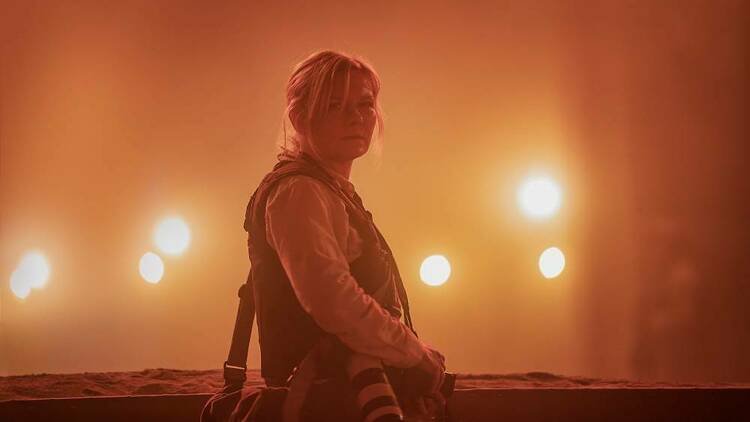
Civil War’s shocking final photograph reveals the movie’s true message about war, journalism, and how history is remembered.
Introduction
Alex Garland’s Civil War (2024) is not a traditional war film.
At first glance, the movie appears to follow a familiar narrative: journalists traveling across a war-torn America to document the fall of the government.
However, Garland’s film is less interested in political explanations and more focused on the role of media during violent conflicts.
This approach makes the ending of the movie particularly disturbing.
Instead of a heroic conclusion or clear moral victory, the film closes with a photograph.
That final photograph is not just a dramatic moment. It represents the central idea behind the entire movie.
Understanding that image helps explain what Civil War is really trying to say about war, journalism, and modern media culture.
The Role Of Journalists In The Film
Throughout the movie, the main characters are not soldiers.
They are journalists.
Their mission is simple: document the war and reach Washington D.C. to interview the president.
But Garland presents journalism in a morally ambiguous way.
The reporters constantly repeat the idea that they must remain neutral observers.
They believe their job is to capture events rather than influence them.
However, the film repeatedly challenges this idea.
Several scenes show journalists photographing tragic events instead of helping victims.
These moments raise a difficult question:
Is documenting violence the same as participating in it?
The Journey To Washington
As the group travels through the country, the audience sees a fragmented version of America.
Different regions are controlled by different factions.
Some towns appear strangely calm, while others resemble active war zones.
Garland intentionally avoids explaining the political causes of the conflict.
Instead, the focus remains on the emotional experience of people living through the collapse.
This choice makes the story feel disturbingly realistic.
The war becomes less about ideology and more about human survival.
The Importance Of Photography
Photography plays a central role in the film.
The main character, Lee, is a famous war photographer.
She believes powerful images can change how people understand conflict.
Throughout history, photographs from war zones have shaped public opinion.
Images from Vietnam, Iraq, and other conflicts often become the defining symbols of those wars.
In Civil War, Garland uses this idea to explore how media influences memory.
The war itself may eventually end.
But the images captured by journalists will remain forever.
The Final Assault
The climax of the movie takes place during the assault on Washington D.C.
The city becomes the final battlefield of the conflict.
As soldiers advance toward the White House, the journalists follow closely behind.
They are determined to capture the moment when the president is finally confronted.
This scene is chaotic and terrifying.
Gunfire, explosions, and confusion fill the screen.
Yet the journalists continue taking photographs.
Even in the most dangerous moments, their instinct is to document rather than intervene.
The Final Photograph Explained
At the end of the film, one image stands out.
A photograph is taken during the final moments of the conflict.
This photograph becomes the final frame of the movie.
The image represents more than just a historical record.
It symbolizes the transformation of real human suffering into a visual artifact.
In other words, tragedy becomes an image that will be viewed by millions of people.
This is the core message of the film.
War is often remembered through photographs rather than through the lives that were lost.
The photograph becomes history.
But the people inside the moment disappear.
Garland’s Commentary On Media Culture
Alex Garland appears to be making a broader statement about modern media culture.
In the age of smartphones and social media, violent events are often captured and shared instantly.
People around the world watch conflicts unfold through images and videos.
But this constant exposure can also create emotional distance.
Viewers may become spectators rather than participants.
The film’s final image reflects this idea.
The photograph is powerful, but it also reduces a complex moment into a single frozen frame.
Why The Ending Is So Disturbing
Many war movies end with a clear sense of victory or resolution.
Civil War refuses to offer that comfort.
Instead, the movie ends with an image that raises uncomfortable questions.
Was the war truly worth documenting if it changed nothing?
Did the journalists help the world understand the conflict, or did they simply turn tragedy into spectacle?
These questions remain unanswered.
And that ambiguity is what makes the ending so effective.
The True Meaning Of Civil War
Ultimately, Civil War is not about politics.
It is about the relationship between violence and storytelling.
The film suggests that wars are often remembered through narratives created by journalists, photographers, and filmmakers.
These narratives shape how future generations understand the past.
The final photograph represents that process.
It captures a single moment.
But it also transforms reality into history.
Final Thoughts
Alex Garland’s Civil War is a challenging and thought-provoking film.
Rather than providing simple answers, the movie forces viewers to confront uncomfortable truths about media, violence, and memory.
The final photograph is not just the end of the story.
It is the entire point of the film.
By ending on that image, Garland reminds the audience that history is often written not by those who fight wars, but by those who record them.
What does the ending of Civil War mean?
The ending suggests that war is ultimately remembered through images and media narratives rather than through the experiences of those involved.
Why is the final photograph important?
It symbolizes how journalists transform real events into historical records.
Is Civil War based on real events?
No, the film presents a fictional scenario but reflects themes relevant to modern conflicts and media coverage.