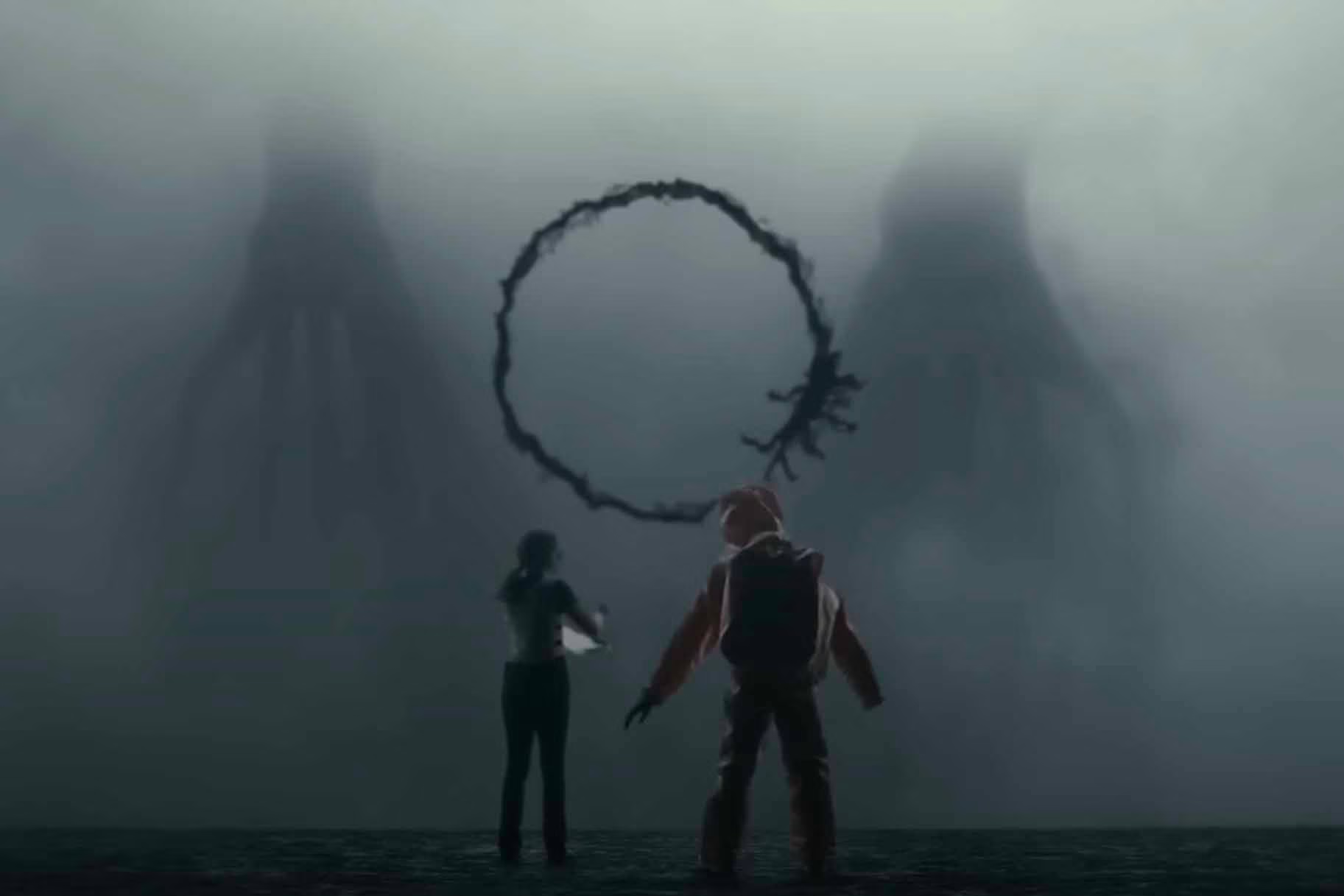
A deep analysis of Arrival’s hidden time loop theory and how Louise’s visions completely change the meaning of the film.
Introduction
Denis Villeneuve’s Arrival is often described as a science-fiction film about first contact between humans and extraterrestrial life. However, the movie is much more than a simple alien invasion story.
At its core, Arrival is about time, perception, and the human ability to understand the universe in ways we never imagined.
One of the most fascinating aspects of the film is the mysterious visions experienced by the main character, linguist Louise Banks.
At first, these scenes appear to be flashbacks of her daughter.
But as the story unfolds, the film reveals a shocking truth that completely changes the meaning of the entire narrative.
Understanding The Alien Language
The alien species in the film, known as the Heptapods, communicate using a unique circular written language.
Unlike human languages, which follow a linear sequence of words, the Heptapod language represents entire sentences in a single symbol.
This structure reflects a completely different perception of time.
Instead of seeing time as a straight line moving from past to future, the aliens experience time all at once.
Past, present, and future exist simultaneously.
When Louise begins learning this language, something extraordinary happens.
Her brain starts adapting to this new way of thinking.
The Sapir-Whorf Hypothesis
The film’s concept is inspired by a real linguistic theory known as the Sapir-Whorf Hypothesis.
This theory suggests that the language we speak influences the way we perceive reality.
For example, different languages categorize colors differently, which can subtly change how people perceive them.
In Arrival, this idea is taken to its ultimate extreme.
By learning the alien language, Louise literally changes the structure of her perception.
She begins experiencing events that have not yet happened.
Why Louise Sees The Future
The movie initially presents Louise’s visions as memories.
These scenes show her raising a daughter who eventually dies from a rare illness.
However, the final act reveals something astonishing.
These scenes are not flashbacks.
They are actually flash-forwards.
Louise is seeing moments from her future.
Once she fully understands the alien language, she begins experiencing time in the same nonlinear way as the Heptapods.
This means she can perceive events before they occur.
The Phone Call Scene Explained
One of the most important scenes in the movie occurs when Louise calls the Chinese general during a tense global crisis.
Human governments believe the aliens may be preparing for an attack.
Louise suddenly knows the exact words she must say to convince the general to stand down.
But how does she know?
Because she remembers a future moment where the general tells her those exact words.
This creates a fascinating time loop.
Louise only knows what to say because she will hear it in the future.
But the future only happens because she says those words now.

Why Louise Still Chooses Her Future
Perhaps the most emotional moment in the film is Louise’s decision to still have her daughter.
By the end of the movie, she already knows what will happen.
She knows her daughter will eventually die.
Yet she chooses to live that life anyway.
This is the true philosophical core of Arrival.
The film suggests that even when we know life contains pain, the moments of love and happiness still make the journey worthwhile.
Louise chooses to embrace life fully, even knowing the heartbreak ahead.
The Real Message Of Arrival
While Arrival appears to be about aliens and language, the movie is really about something far more universal.
It explores the idea that our perception of time shapes our experience of life.
Humans normally see time as a straight path moving toward the future.
But if we could see our entire lives all at once, would we still make the same choices?
Louise’s answer is clear.
Yes.
Because even temporary moments of love are worth experiencing.
Final Thoughts
The hidden time loop theory in Arrival transforms the entire story.
What begins as a mystery about alien communication ultimately becomes a deeply emotional reflection on human existence.
By learning the alien language, Louise gains the ability to see her future.
Yet instead of trying to change it, she chooses to accept it.
This decision turns Arrival into one of the most thought-provoking science-fiction films ever made.

What is the hidden meaning of Arrival?
The movie explores how language can change human perception and suggests that time may not be linear.
Why does Louise see the future?
Learning the alien language rewires her brain to perceive time in a nonlinear way.
Why does Louise still have her daughter?
Because she believes that the joy of experiencing love outweighs the pain of losing it.